NGV Australia
Last minute dash to NGV Australia this morning before flying home to Newcastle. Of course great that the First Nations collection is now celebrated on the ground floor - but also really impressed by the meaningful integration of historical and contemporary First Nations works throughout the displays. I’d seen and heard a lot about the Bark Salon - but it really is breathtaking.
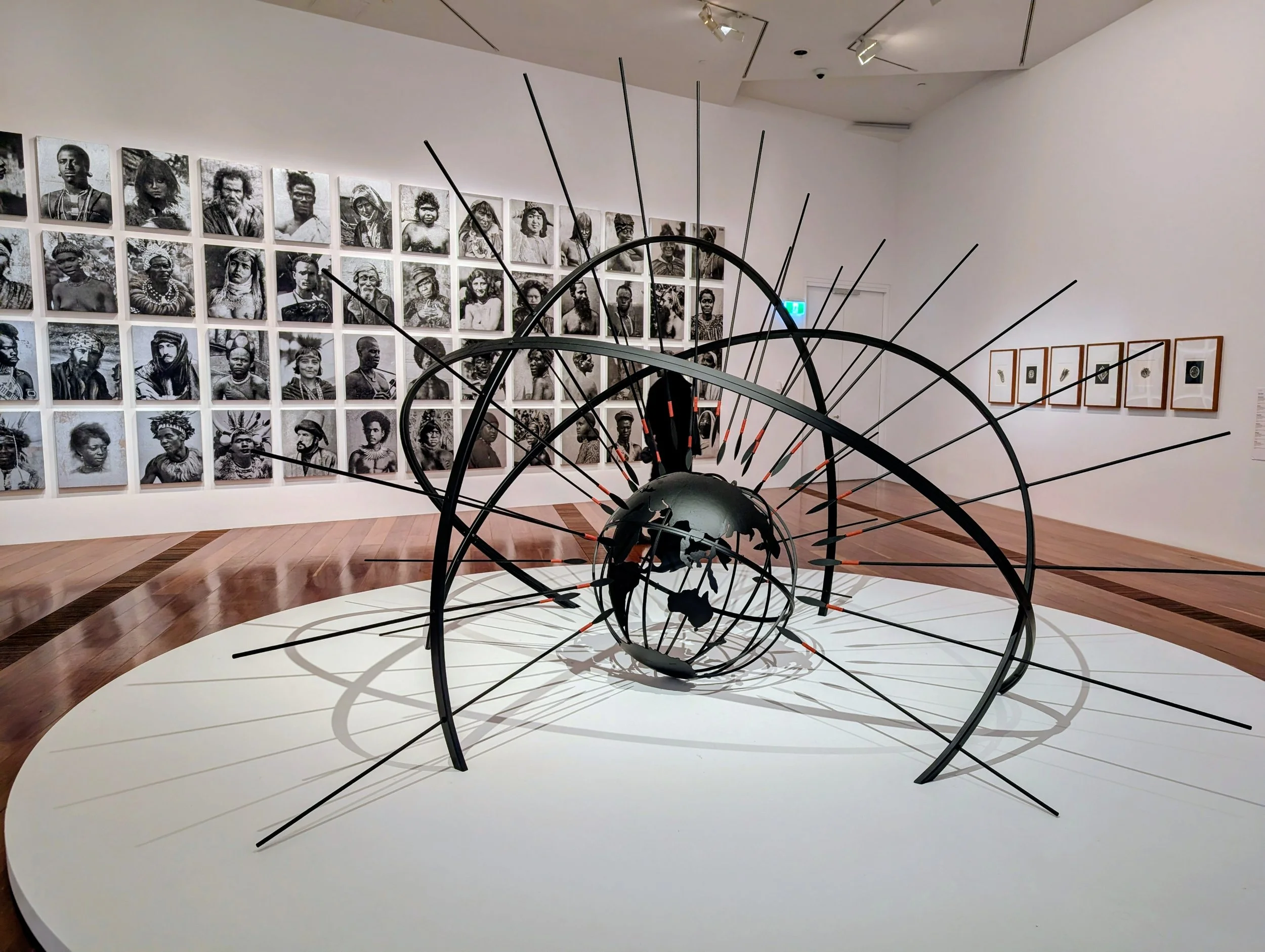
Warraba Weatherall
InstitutionaLies
2017/2025
steel, aluminium, string
From the wall label: ‘InstitutionaLies was originally made to commemorate the Royal Commission into Aboriginal Deaths in Custody (1987- 90). The work features a central globe encircled by a craniometer, a device used by eugenicists and anthropologists in the nineteenth and twentieth centuries to measure and study First Peoples with the intent to confirm racially motivated hypotheses related to the theory of evolution. Both the globe and craniometer are surrounded by a series of spears pointing inwards. Together these elements foreground historical and ongoing systemic and institutional racism, and, according to the artist, intend to 'place Western gaze under scrutiny by First Peoples'.
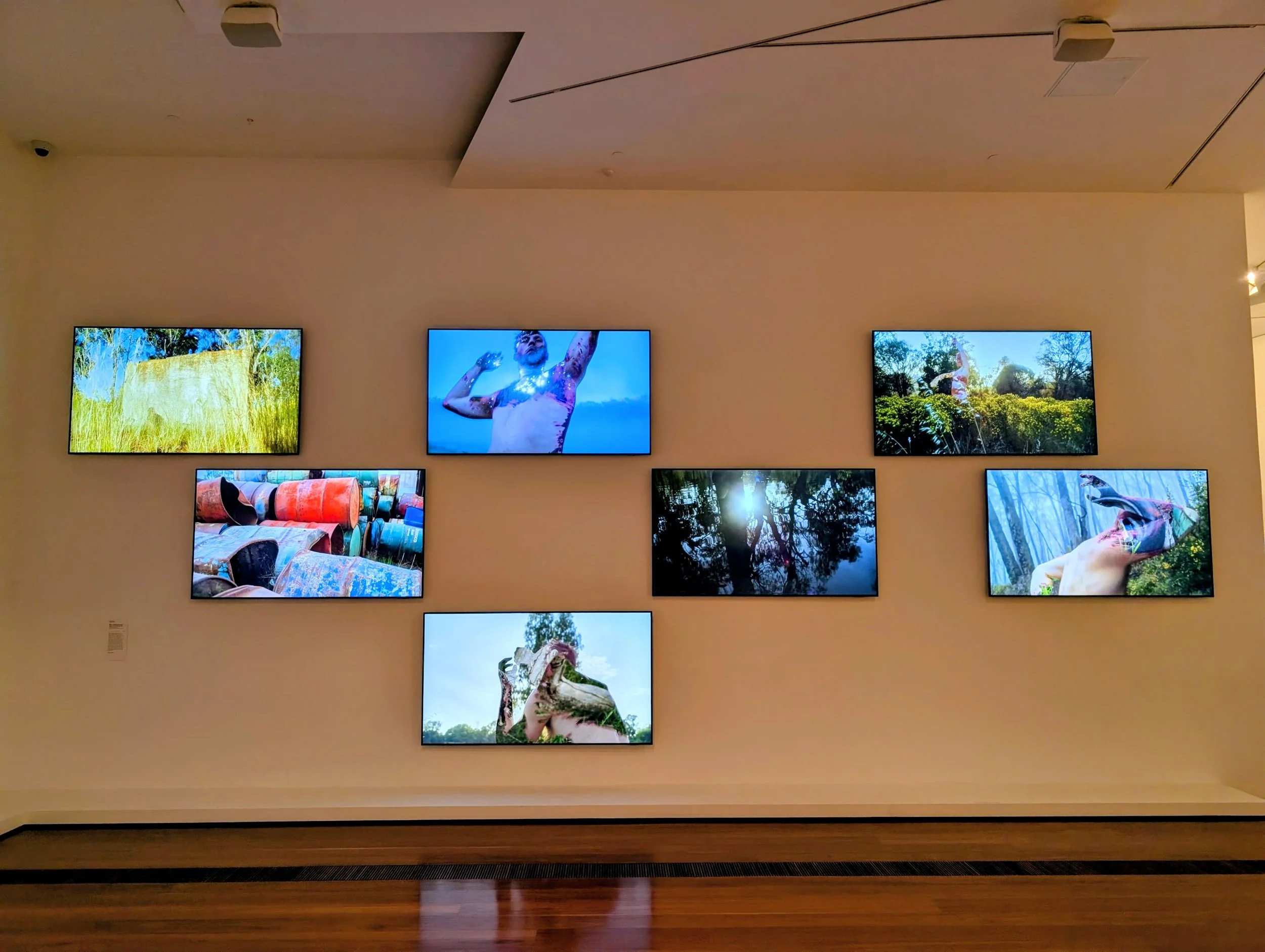
Joel Bray
Giraru galing ganhagirri (The wind will bring rain)
2022
seven-channel video installation, sound
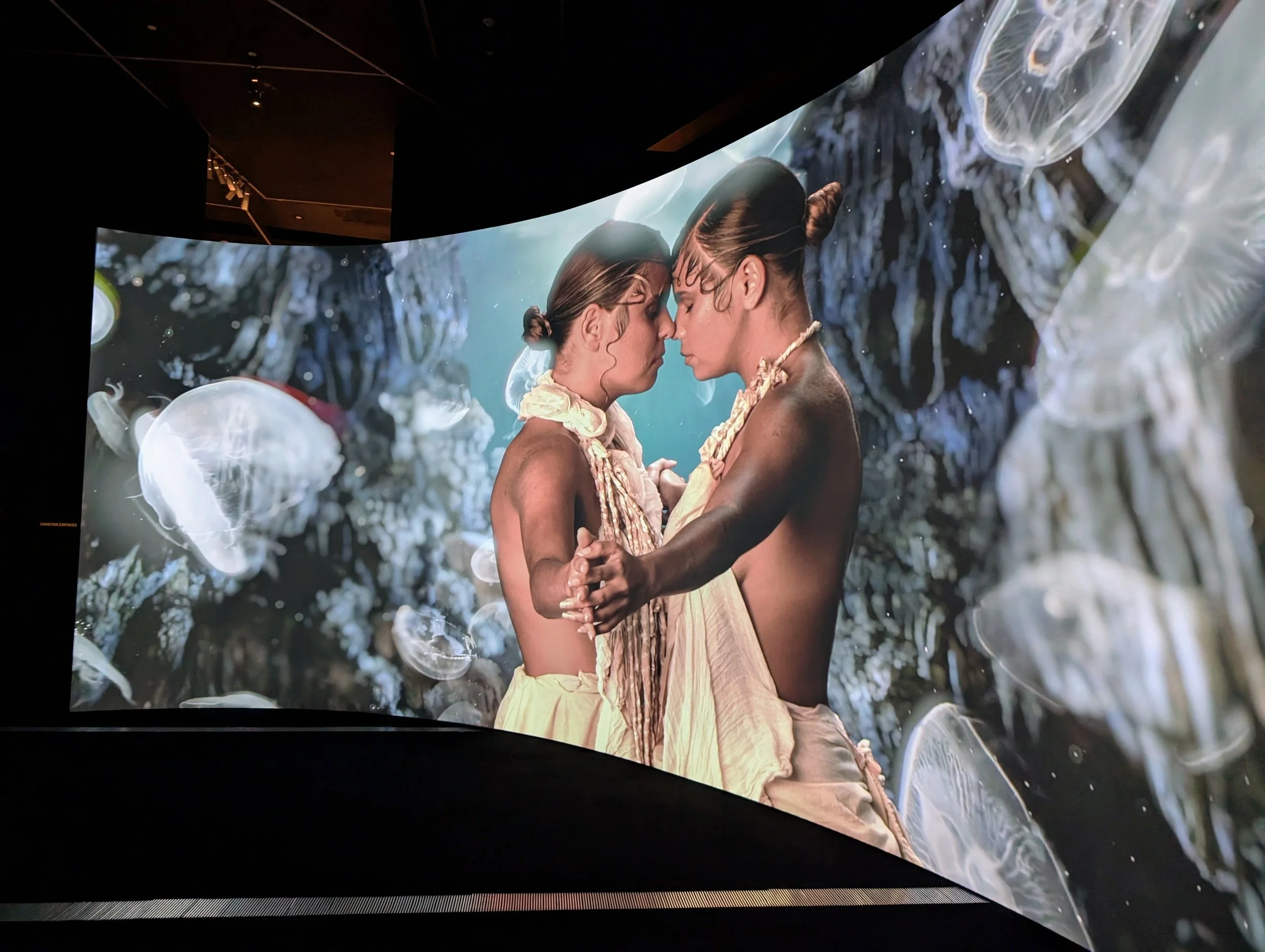
From the wall label: ‘Giraru galing ganhagirri explores Joel Bray's connection with his ancestral Wiradjuri Country. Throughout the video, Bray conveys the body as both porous and resilient, liminal and grounded. Covered with layered imagery of Country, Bray's body seemingly merges with its surroundings. According to the artist, Giraru galing ganhagirri speaks to 'the implacable force of Country, the meeting of the elements of air and water and of the assurance that, in nature, one thing follows another. Always have and always will. In these times, we find solace in the "ancientness" and endurance of Country. Whatever happens, the wind will always bring the rain.’
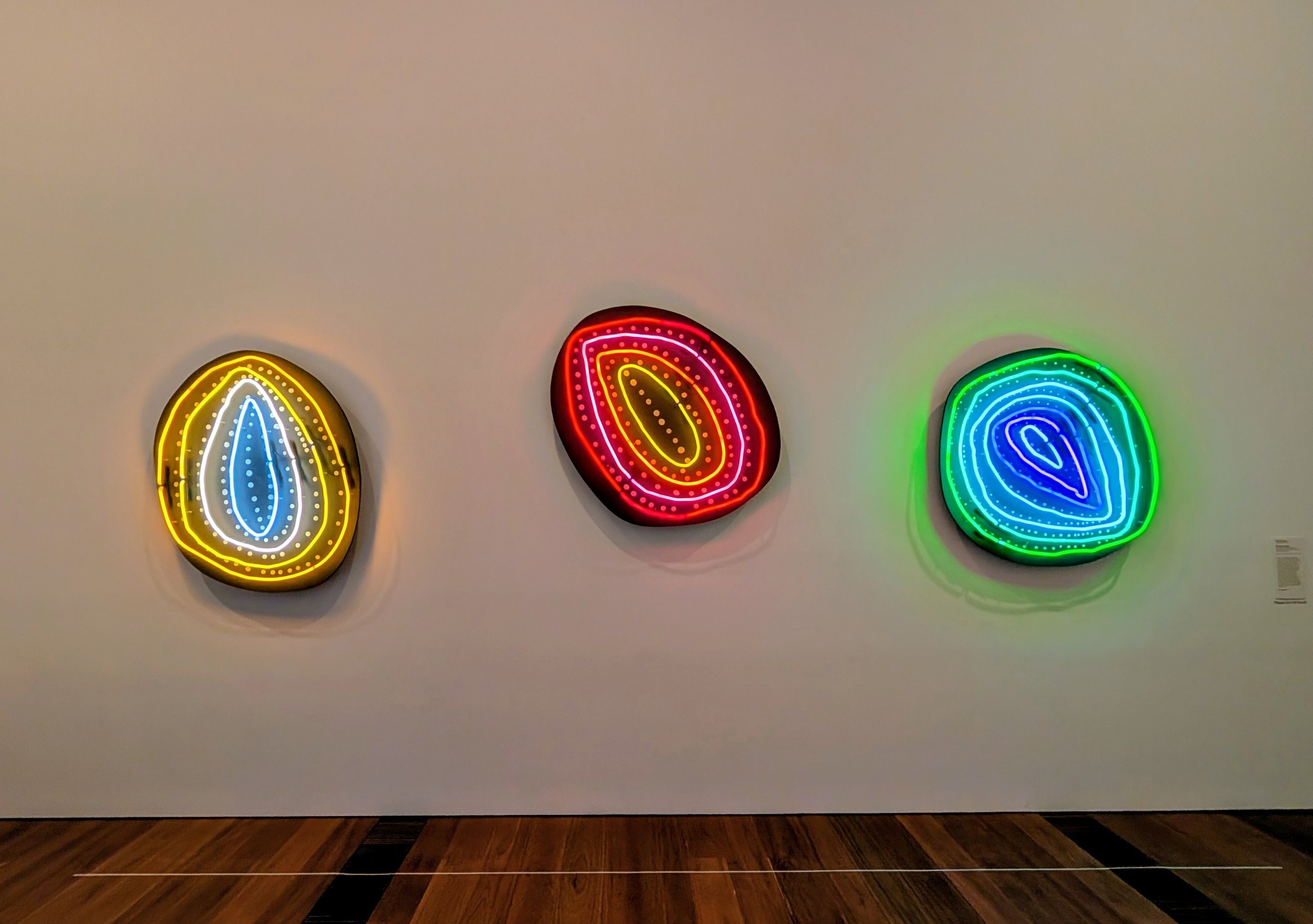
Alice Guiness
Burndud ground
2025
synthetic polymer paint on plywood, neon, electrical components
From the wall label: ‘The Burndud circle is an important site and story for the Yindjibarndi people of the north-west Pilbara. A sacred law ceremony to initiate young boys, it was taught by the Marrga (ancestral creation spirits who shaped and named their Country) in the times of Ngurra Nyujunggamu (when the world was soft, the learning times). Elder and senior artist Alice Guiness holds a deep connection with the Burndud. In these works. Guiness mirrors the ceremony she dances each year in a continuous, circular motion until the young boys have returned. Her use of bold colour and vibrating pattern embody the movement of the women dancing and the men singing, while her use of neon propels Yindjibarndi creative and cultural practice into the future.’
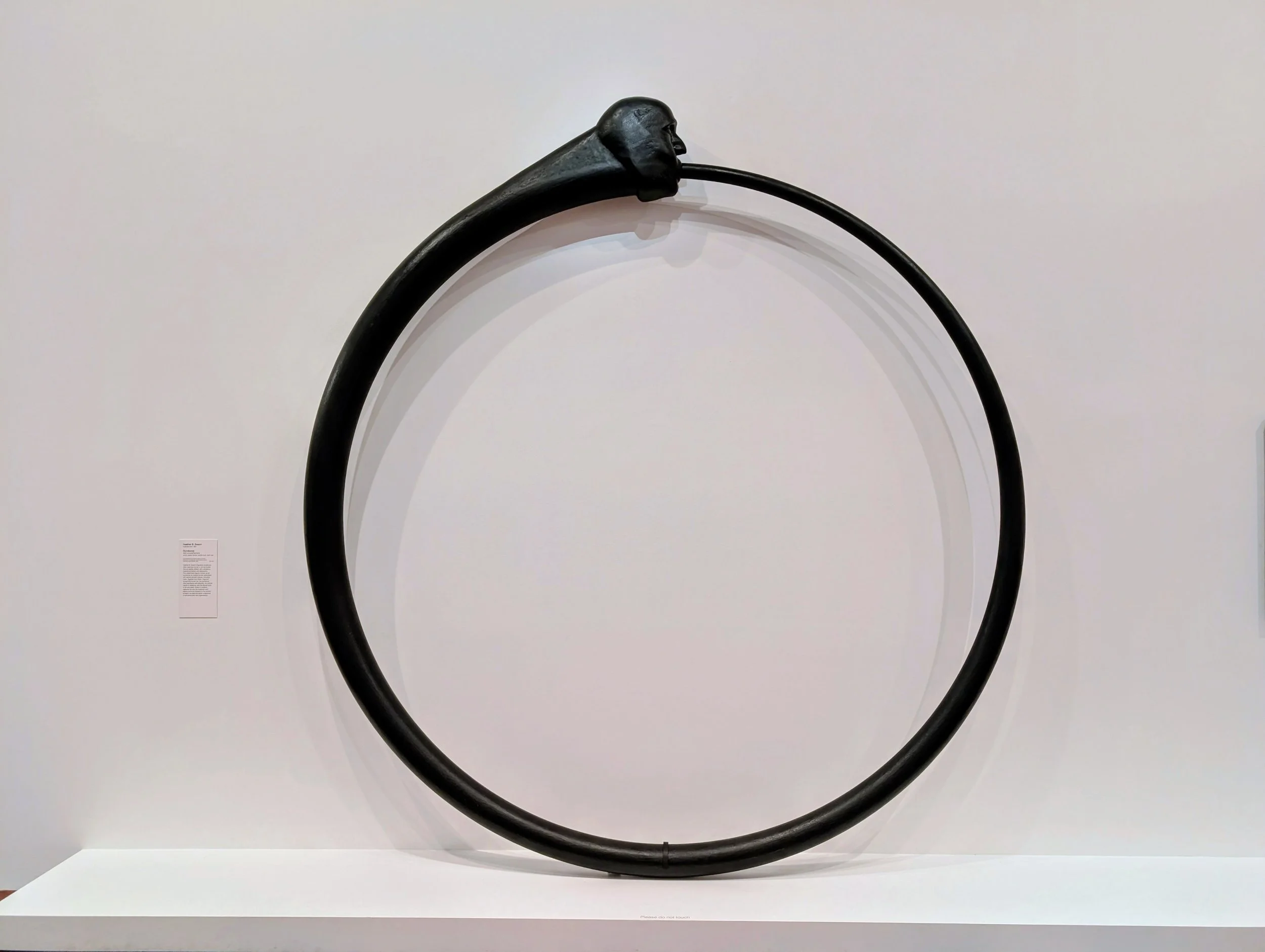
Heather B. Swann
Ouroboros
2023
wood, paper, binder, marble dust, stain wax
From the wall label: ‘Heather B. Swann's figurative sculptures often resemble human or animal bodies that are slightly altered, with a tendency towards surrealism and abstraction. This coiled black figure is known as an ouroboros, an arcane symbol associated with various ancient cultures, including Celtic, Egyptian and Greek. Depicted consuming its own tail, the ouroboros often represents self-reflexivity, the cyclical nature of existence, and the eternal cycle of life and death. Swann's rendition captures not only the mysticism and eternal continuity inherent to this ancient emblem, but also the darker undertones of self-destruction and regeneration.’
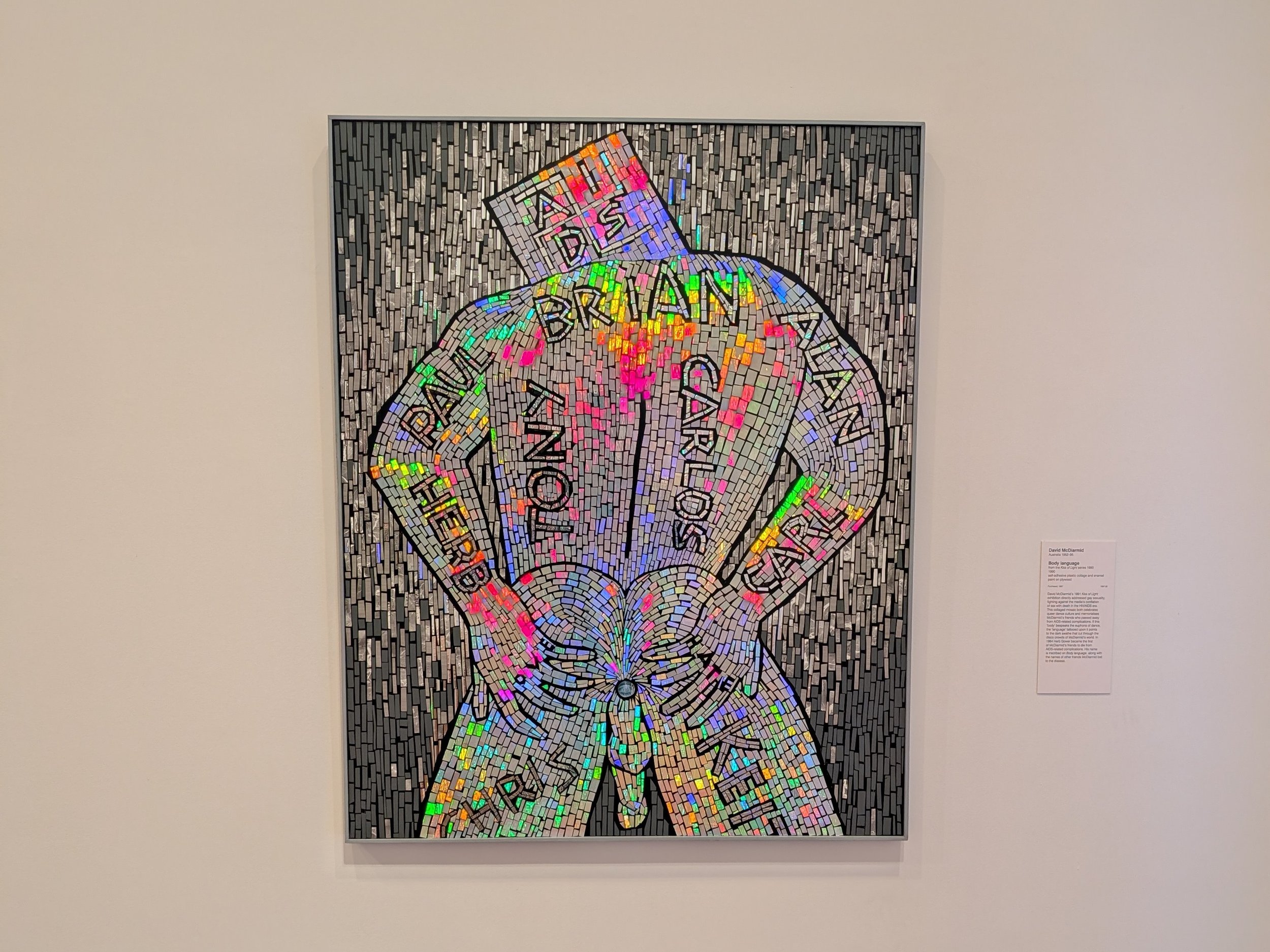
David McDiarmid
Body language (from the Kiss of Light series)
1990
self-adhesive plastic collage and enamel paint on plywood
David McDiarmid's 1991 Kiss of Light exhibition directly addressed gay sexuality, fighting against the media's conflation of sex with death in the HIV/AIDS era. This collaged mosaic both celebrates queer dance culture and memorialises McDiarmid's friends who passed away from AIDS-related complications. If this 'body' bespeaks the euphoria of dance, the 'language' tattooed upon it points to the dark swathe that cut through the disco crowds of McDiarmid's world. In 1984 Herb Gower became the first of McDiarmid's friends to die from AlDS-related complications. His name is inscribed on Body language, along with the names of other friends McDiarmid lost to the disease.
Nunami Sculthorpe-Green
takila milaythina-ti
2025
native harvested clay, stone, pigment, and ash on stoneware ceramics
Mentor: Aunty Lola Greeno, Trawlwoolway Acknowledgment: Isabelle Moustra, Too Friendly Ceramics and Ben Richardson, Ridgeline Pottery
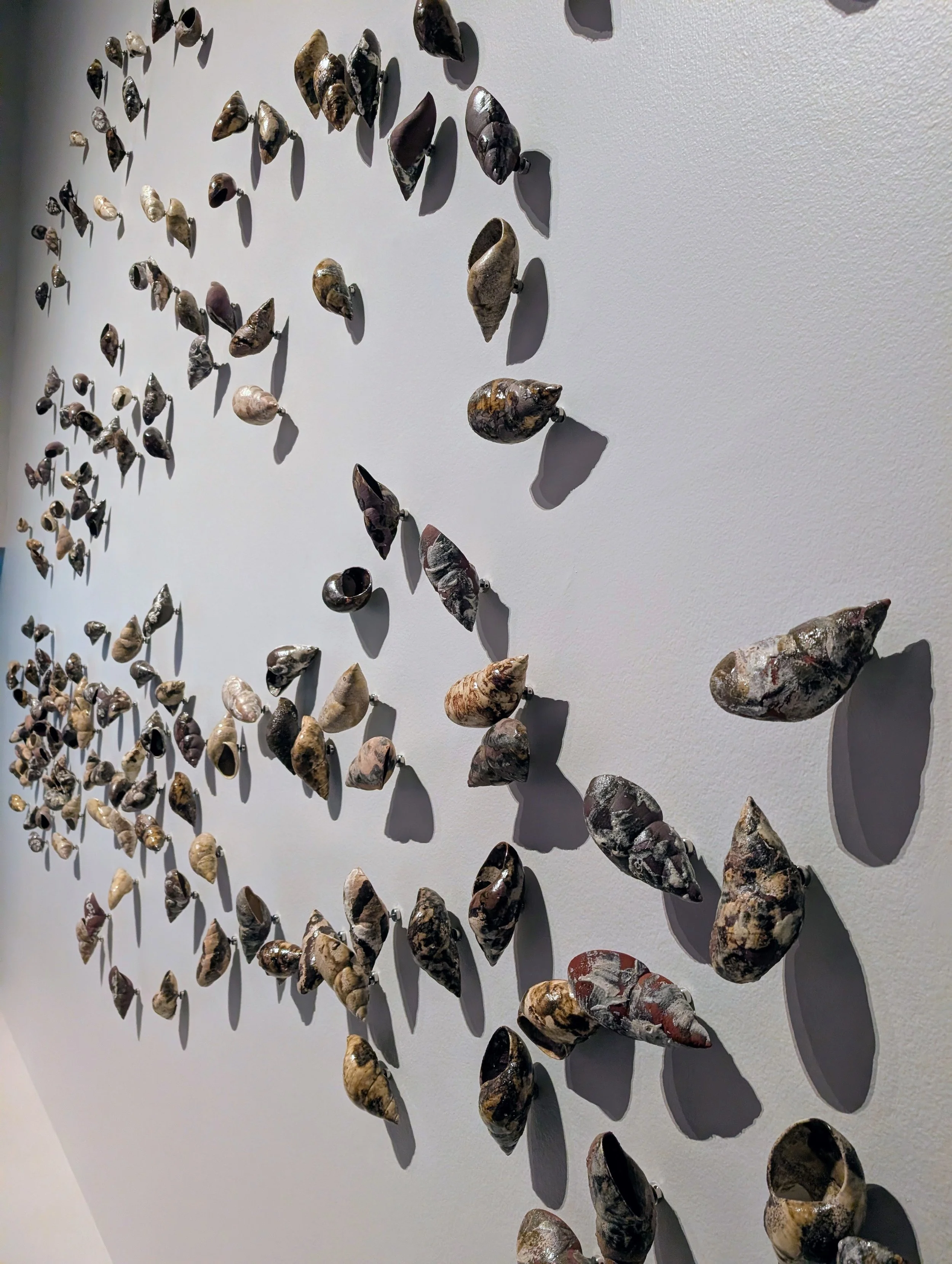
From the wall label: ‘Nunami Sculthorpe-Green is a Palawa and Warlpiri woman born and raised in Nipaluna/Hobart. She is a storyteller working across writing, visual art and performance, and grounds her work in ideas of seasonality and the recentring of often overlooked histories and stories connected to place. takila milaythina-ti is a sprawling bed of 200 slip-cast marina shells, enlarged in scale and hand-painted with a unique glaze hand-made from natural materials sourced from Nunami's ancestral Country in northwest Lutruwita. The shells are arranged as a collective and in a formation reflective of the undulating lines formed by clusters of marina shells that once covered Lutruwita's coastlines. With these shells now endangered, takila milaythina-ti tenderly conveys the profound cultural significance marina shells play in stringing past, present and future while also bringing the ongoing impacts of climate change and industry on Country, community and culture into sharper focus.’
Hannah Brontë
EYE HEAR U MAGIK
2020
colour digital video, sound
From wall label: ‘EYE HEAR U MAGIK explores the mother. the doula, the sister, the twins, the oracle, the orator and the new born. Understanding that, yes, we inherit grief and sadness through our familial lines but we also inherit joy, skill, Magik, cheekiness, psychic abilities and physical strength.’
- Hannah Brontë, 2025